
An employee who spends an hour preparing a routine summary has a reasonable question: could AI help? The answer starts with the summary, its audience, and the information involved. Buying access for the whole office comes later.
Give the pilot a review and an ending
A bounded task should produce a decision about whether the workflow is worth keeping.
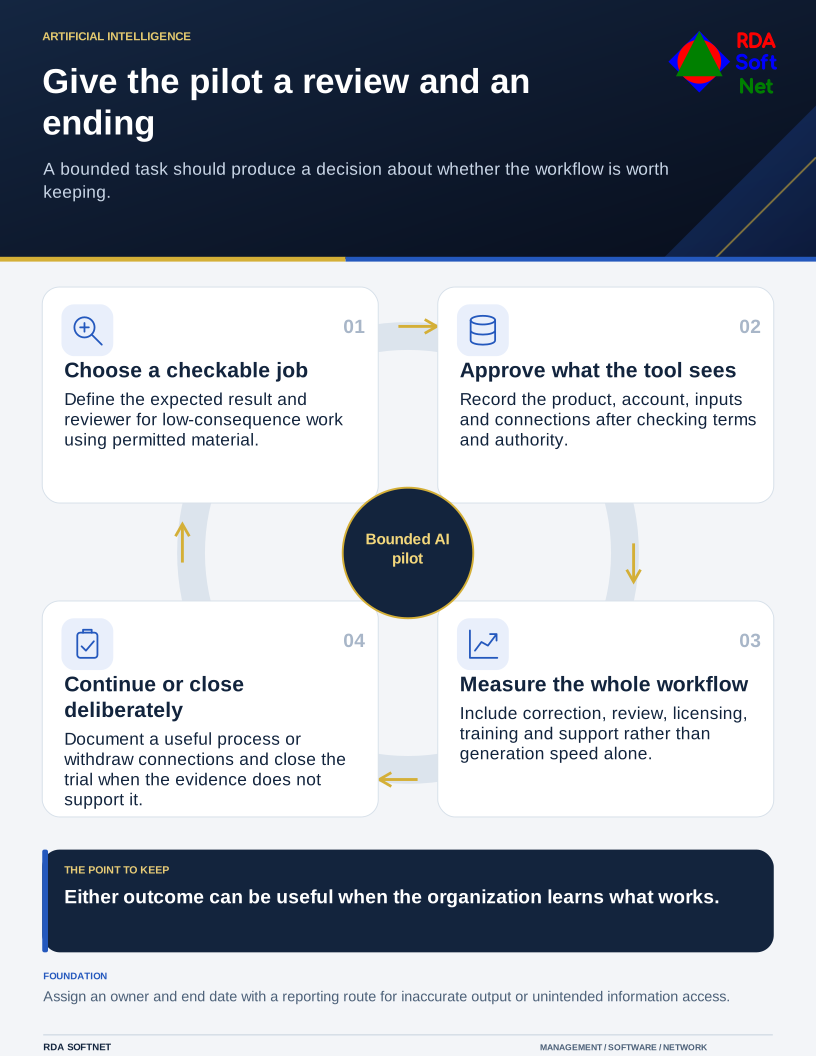
RDA approaches AI as a change to the way work gets done. The person responsible for the work should help define the experiment, alongside IT and anyone responsible for the information. That makes it possible to judge whether the tool helps without quietly changing privacy obligations or handing decisions to software.
Choose a task you can check
A first pilot might turn an approved public document into a proposed outline or help prepare questions for a meeting. Agree on the expected result and a way to compare it with the current process. Count the time spent checking and correcting the working version, as well as the time spent generating it.
Avoid starting with decisions about eligibility, employment, public safety, or other consequential matters. A convincing paragraph can conceal a factual mistake. The reviewer needs enough subject knowledge to find that mistake and enough time to correct it.
NIST's AI Risk Management Framework treats evaluation and risk management as part of using AI systems. It provides a useful starting point for decisions about an approved pilot; it does not certify a particular tool or use case.
Decide what the tool may see
Write down which account and product are approved, what information may be entered, and which connections are allowed. A paid subscription alone does not answer questions about retention, training, subcontractors, or the right to upload someone else's material.
Use test information where possible. If the pilot needs live records, the information owner must approve that use after the terms and applicable obligations have been checked. Our AI use guidance covers those decisions, and data governance explains how information handling fits into everyday work.
Connections deserve their own review. A writing assistant that reads one selected document is a different proposition from an assistant granted access to an entire shared drive. Record the permissions, who approved them, and how they can be withdrawn. Do not assume existing broad file permissions become appropriate merely because AI makes those files easier to find.
Make the result somebody's responsibility
Give the pilot an owner and an end date. Staff should know where to report an inaccurate answer, an unexpected disclosure, or a request for additional access. Keep only the records needed to evaluate and support the trial; copying every confidential prompt into another log can create a second information problem.
At review, ask a practical question: would the department choose to keep this workflow after paying for the license, review time, training, and support? If yes, document the process and teach a second person to run it. If no, remove the connection and close the trial properly. Either result is useful when the organization learns what works.