
A small supplier contract can create a large operational dependency. A specialist application may hold essential records. A support company may administer network equipment. An inexpensive add-on may have permission to read a much larger document library.
Review the supplier by its reach
A small contract can create consequential access or an essential operating dependency.
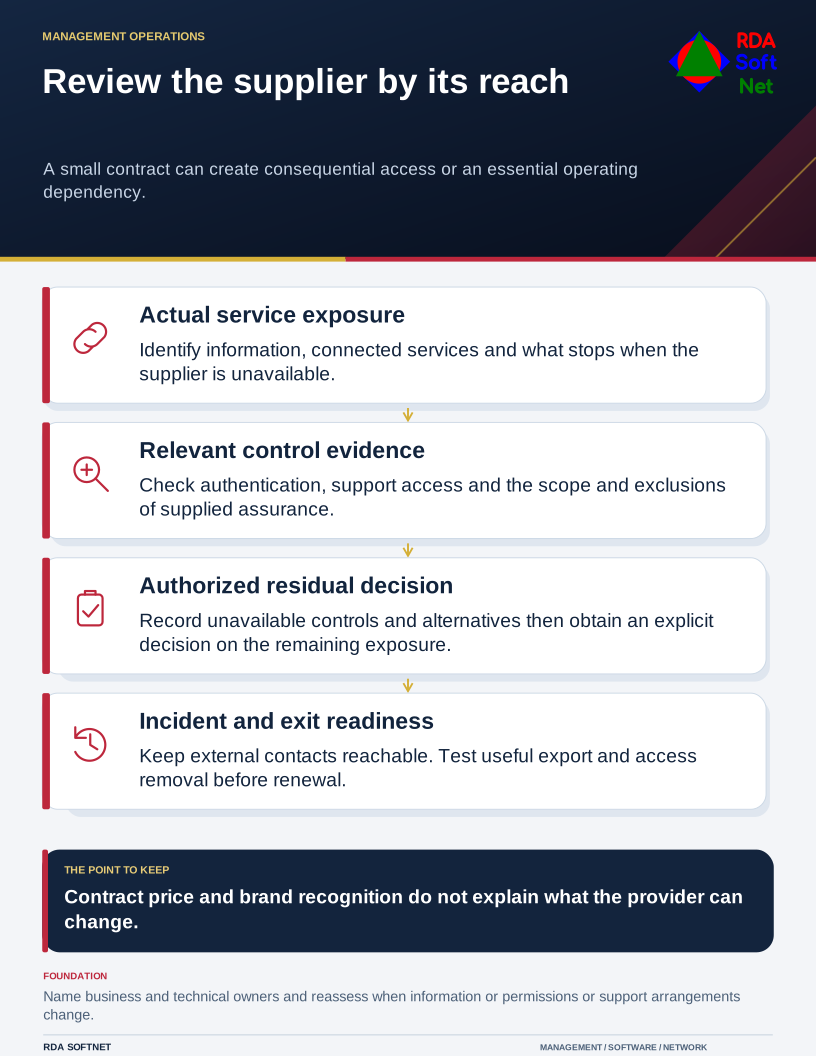
Review the relationship according to those effects. Contract value and brand recognition are background information; they do not explain what the supplier can change or how the organization would work without it.
Describe the dependency in ordinary terms
Identify the business owner, information involved, connected services, and support access. Include subcontracted processing where it matters. Ask the department what would happen if the provider became unavailable or reported an incident.
That becomes the basis for a proportionate vendor review. An application handling confidential case records needs a different assessment from a service displaying public information. A long questionnaire should not displace the few questions that determine whether the actual arrangement is acceptable.
NIST's supply chain risk guidance incorporates supplier risk into organizational risk management. Use that principle throughout the relationship, including acquisition, changed access, operation, and exit. A favorable review at purchase is not a permanent conclusion.
Match evidence to the service
Ask about authentication, access administration, updates, information handling, recovery, and incident contacts. If a report or certification is supplied, check the product, locations, period, and exclusions it covers. Determine which controls remain the customer's responsibility.
Prefer identifiable, limited support access over an unexplained shared administrator login. Establish the approved route, authentication, authorization, and review or expiry. Where an application connects automatically, use the integration guide to review permissions and credentials that can operate without someone visibly signing in.
Some requested controls may be unavailable. Record the gap, its consequence, and alternatives, then obtain the authorized decision. A provider's silence should not be interpreted as acceptance, and a refusal is not automatically proof of wrongdoing. Management needs enough facts to decide whether the remaining exposure is acceptable.
Prepare for change and trouble
Keep an incident contact reachable outside the affected application. Clarify what information the supplier will provide about impact, mitigation, recovery, and customer action. Notification and assistance terms should reflect the applicable law and contract rather than an assumed universal deadline.
Link those arrangements to the incident response plan. If access must be restricted or the service paused, the technical and department owners need an agreed decision route. Preserve evidence and coordinate actions so separate providers do not inadvertently obstruct one another.
Before renewal, check whether useful records can be exported and what assistance is available. The cloud exit guide covers testing, access removal, cancellation, and disposition of data. A contractual right to retrieve information is more useful when somebody has tested the retrieval.
Finish with a record another authorized colleague can use: what the supplier provides, which permissions it holds, who answers questions, and what remains unresolved. Revisit it when the service, information, or support arrangement changes.