
A website may collect information without asking a visitor to create an account. Hosting logs, form submissions, analytics, embedded media, and support widgets can each involve different services and records. The privacy notice should describe the actual arrangement, not only the fields visible on the contact page.
Trace one website visit beyond the page
Visible form fields show only part of the information path.
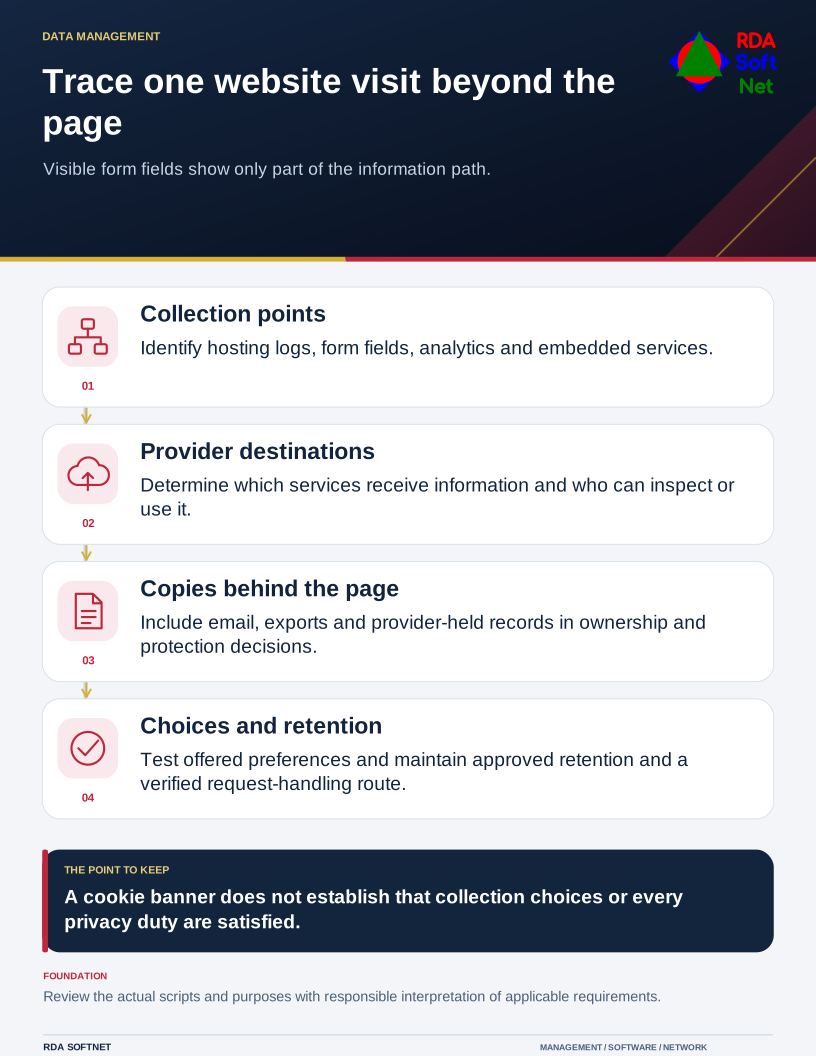
For an organization operating a website, begin by following one visit and one form submission. Identify which providers receive information, who can inspect it, and what happens after the visitor completes the task. Include exports and email copies created behind the page.
Separate useful functions from optional collection
Cookies can support sign-in sessions, preferences, and other site functions; they can also be used for tracking. They are not all the same, and deleting one cookie does not remove every record a site or provider has collected.
Mozilla's cookie documentation explains the technical mechanism and common uses. Check the actual scripts and services loaded by the website, including tools introduced by a template, marketing service, or embedded application. A list of vendors in an old policy may miss a recent addition.
Use the website security guide to connect technical ownership with controlled changes. A new analytics widget is also a change to information handling, even when adding it takes only a few lines of code.
Collect for a purpose the organization can explain
Ask why each form field and tracking event is needed. Avoid collecting sensitive details in an unrestricted comment field where a simpler request would suffice. Provide another route when a visitor needs to discuss information unsuitable for the form.
The FTC's personal information protection guide supports understanding information flows and reducing unnecessary collection. Apply the organization's specific legal, contractual, and records obligations with the responsible adviser. Requirements for consent, notices, and individual rights differ by jurisdiction and activity.
The data governance guide helps assign purpose, ownership, access, and retention. The vendor review guide covers providers receiving the information. A cookie banner does not, by itself, settle every obligation or prove that the site's choices are implemented correctly.
Test the promises and the response route
If visitors are offered a choice about optional collection, verify the website's behavior for each choice. Check the live site after material changes rather than relying only on a design document. Protect information in logs and exports as well as the main application.
Set an approved records retention process and a contact for privacy questions or requests. Verify identity proportionately and use the applicable requirements when deciding what information may be supplied, corrected, or removed. Do not promise deletion where another obligation requires preservation.
Finish the review with a current data-flow record, accurate public information, and owned corrective actions. The website team, department owner, and computer department should be able to explain the same process. That shared understanding is more useful than a reassuring notice that no longer matches the service.