
A security label can help someone ask better purchasing questions. It cannot determine whether a camera belongs on the organization's network, who may view its recordings, or what happens when its cloud service stops working. Those remain decisions about the proposed use.
Product evidence and deployment decisions
A consumer IoT label informs a review without approving the organization's proposed use.
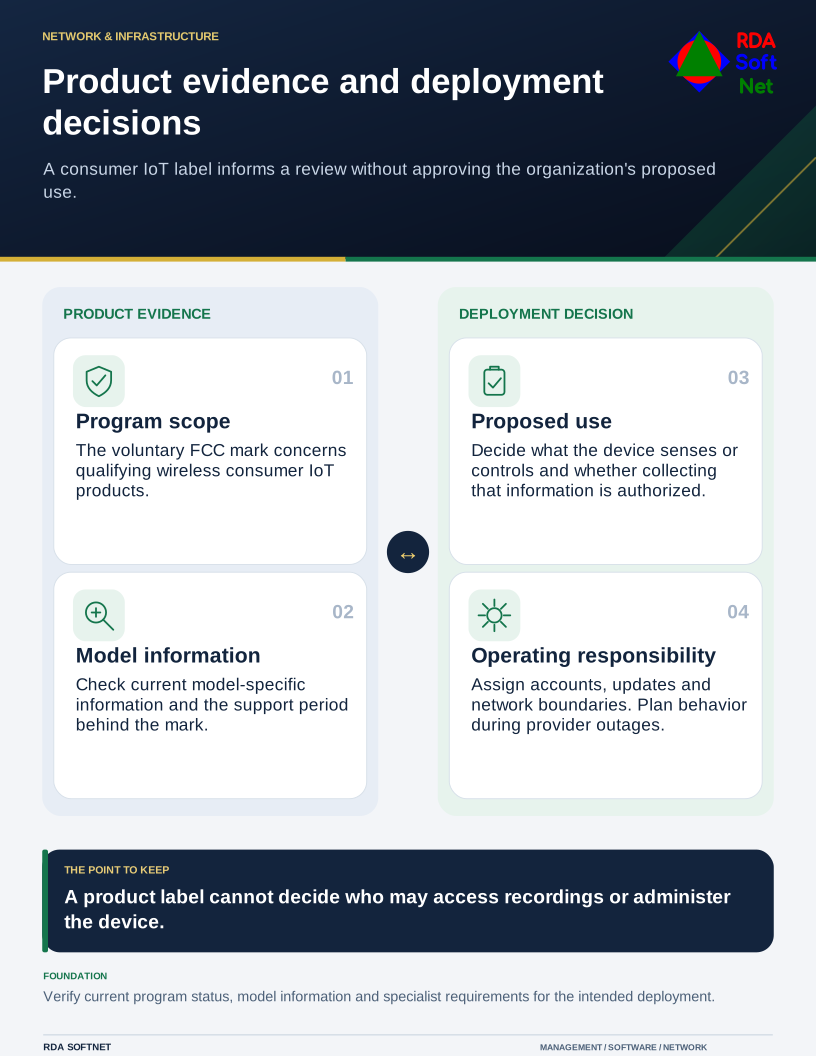
The U.S. Cyber Trust Mark is a voluntary FCC cybersecurity labeling program for qualifying wireless consumer Internet of Things products. It should not be read as a guarantee against compromise or as a universal approval for enterprise, medical, public safety, or other specialized deployments.
Understand the information behind the label
The FCC's published labeling rules pair the mark with a QR code leading to product information. The design includes information about the support period. Check the specific model and its current information rather than assuming a logo covers an entire manufacturer's range.
NIST's consumer IoT baseline profile considers product cybersecurity capabilities and can also help smaller organizations assess purchases. It is a useful starting point, not a substitute for reviewing the organization's needs and applicable requirements.
Program arrangements and participating products can change. Verify current availability and product status when purchasing. This archive article is an explanation of the decision process, not a promise about which labels will be on store shelves on a particular date.
Ask what the device will connect to
List the device, mobile app, cloud account, and any integration it needs. Identify what it senses, records, stores, or controls. A thermostat, meeting-room camera, and door control can create very different consequences even if all are called smart devices.
The connected devices guide helps assign ownership, configuration, updates, and retirement. Decide who controls the account and how access survives a staff departure. Avoid making a personal phone or consumer email account the organization's only administrative route.
Check privacy and records implications before enabling audio, video, location history, or remote access. A product's baseline cybersecurity assessment does not settle whether collecting or retaining that information is authorized.
Plan its support and eventual exit
Use network separation to define only the communications the device needs. A separate wireless name does not prove the boundary works. Test the actual pathways and include the device in maintenance and incident reporting.
Confirm update responsibility, support dates, recovery, service fees, export options, and behavior during internet or provider outages. The vendor review guide connects the product with its ongoing service relationship. Keep those details in the asset lifecycle record.
Retain the model-specific product information with the purchasing decision, then set a review for its support period and service changes. A labeled product may contribute useful evidence; an unlabeled product needs its own reasoned review. In either case, the department must know who will update it, administer it, and remove its access when it is retired.