
A quick AI-generated answer can leave a surprising amount of work behind it. Someone must check the facts, establish whether the source material was appropriate, and decide what can be used. If that effort is ignored, a fast demonstration can become a slow and unreliable operating process.
Count the work around an AI answer
Evaluate the complete task rather than the time to produce the first answer.
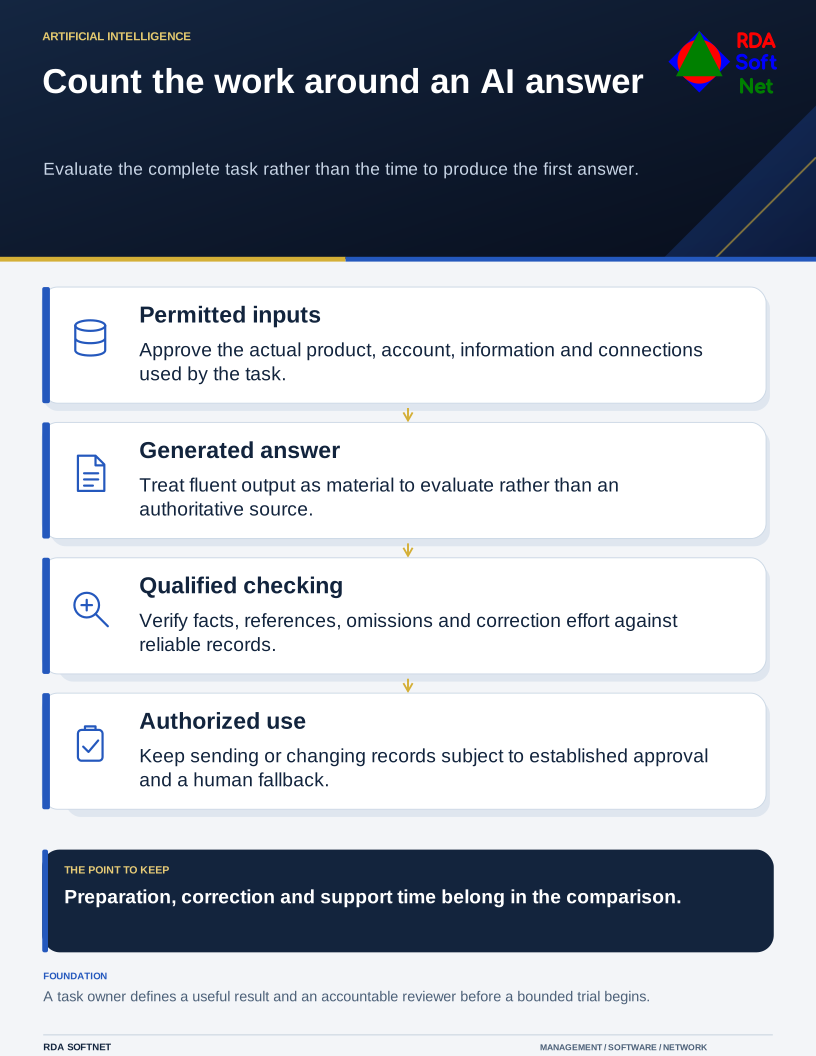
Start with the task the department needs to complete. A useful AI experiment has an owner, a permitted information source, and an outcome that a person can assess. It should also have a way to finish the work if the tool is unavailable or produces an unusable result.
Count the checking as part of the task
Ask a subject expert to review representative outputs against authoritative records. Check names, calculations, references, and omissions rather than judging only whether the writing reads smoothly. A plausible explanation can still contain an invented source or miss an important exception.
NIST's generative AI risk profile addresses risks including inaccurate output, harmful bias, and information handling. Use it to inform an evaluation appropriate to the proposed work. It is guidance, not a certificate that a chosen tool or result is safe.
Compare the complete task with the existing process. Include preparation, correction, approval, training, and support time. The AI governance guide helps define that review before a trial quietly becomes a service the department depends on.
Keep information and authority within scope
Decide which product, account, inputs, and connections are approved. Check the actual terms and configuration rather than assuming every paid service handles information the same way. A public-document exercise is a different decision from uploading personnel records or connecting a departmental mailbox.
Apply data governance to prompts, attachments, outputs, and any retained history. A document with names removed may still contain confidential or identifiable information. An output may also need protection even when it was generated from several individually harmless inputs.
Review actions separately from drafting. Preparing a proposed response should not silently authorize sending it, changing a record, or making an employment decision. Established approval responsibilities remain in place when AI assists with the work.
Make the process understandable to a second person
Document the agreed use and show staff how to report an inaccurate answer or accidental disclosure. Allow time for questions about how the task changes their role. Training should include when to stop, not just how to produce a more polished prompt.
The controlled automation guide becomes relevant when the tool can take actions or trigger further work. Define a stopping point and a human handoff for incomplete or conflicting requests.
RDA helps departments and the computer department evaluate the full workflow. Continue the use when the evidence supports it, narrow it when the limits become clear, and close the trial properly if it does not help. The useful result is a decision the organization can explain and a process its staff can actually support.