
A customer spreadsheet can be exposed without an attacker breaking through a firewall. It may be shared with the wrong account, left in a departed employee's workspace, or retained in an unnecessary export. Preventing those mistakes requires attention to how information moves through ordinary work.
Follow one sensitive dataset
Exposure can arise during ordinary collection or sharing without a firewall being breached.
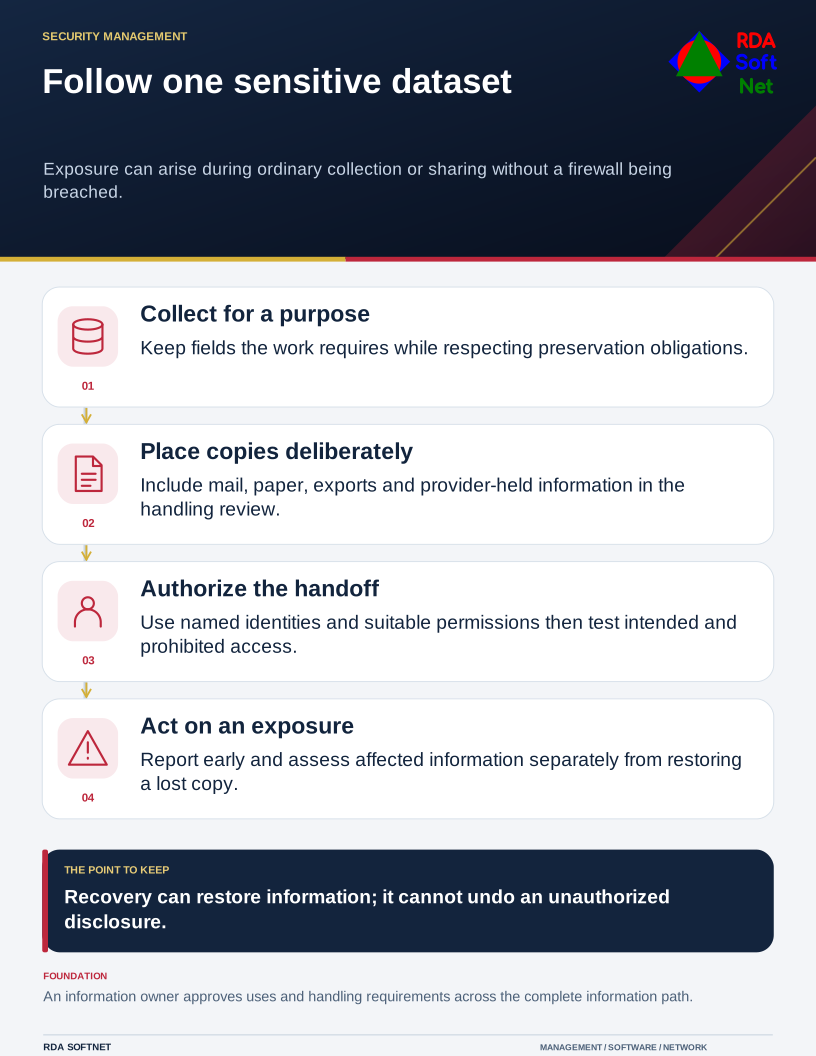
Start with a consequential dataset and follow its path. Who collects it? Why is each field needed? Which people and services receive a copy? Who decides when the information may be removed? That creates a useful basis for security work the department can recognize.
Keep what the work requires
The FTC's personal information protection guide recommends understanding information flows and reducing unnecessary collection and retention. Apply that principle alongside the organization's specific records obligations. Collecting less is useful; deleting required evidence is not.
Use data governance to name an information owner and agree permitted uses. Include downloads, paper, email attachments, test data, and provider-held copies in the review. A carefully configured main application does not control a copy that has already left it.
Keep sensitive information out of unrestricted fields when it is unnecessary. Give staff a defined route for cases requiring special handling, rather than relying on them to invent a suitable storage location during a busy transaction.
Check authority and the systems behind it
Assign named accounts and permissions appropriate to the person's role. Review changes and departures through user credential management. Include application-specific identities and external guests, not only the central directory.
Maintain supported devices, current applications, and useful security monitoring. Verify protection and update results rather than counting installations alone. The endpoint security guide connects those controls with exceptions and follow-up ownership.
Protect transfers and stored information with appropriate encryption, while retaining control of the accounts and keys involved. Encryption does not stop an authorized recipient from sending a file onward or a compromised account from reading what it is allowed to open.
Test the handling, then prepare for failure
Try representative sharing scenarios with approved test information. Check the intended recipient and an account that should not have access. Confirm who can change permissions and how temporary access is reviewed. A policy saying links are restricted should be reflected in the actual settings.
Test recovery as well, but keep its purpose clear. A backup can help restore lost information; it cannot make an unauthorized disclosure disappear. The breach assessment and notification guide addresses the separate responsibility for evaluating affected information and applicable duties.
The FTC's response guide supports prompt, coordinated assessment when something goes wrong. Staff need an accessible reporting route and a reason to report early.
Give each finding an owner and a completion check. Review the results after changes and repeat the relevant tests when a workflow or provider changes. The department should be able to show where its sensitive records belong and who can use them, without relying on a promise that one checklist prevents every breach.