
An alert says an email address appeared in an exposed dataset. It may describe a current credential, an old password, public contact information, or a record whose origin is uncertain. Those possibilities need different follow-up. The alert is the start of a review, not a completed investigation.
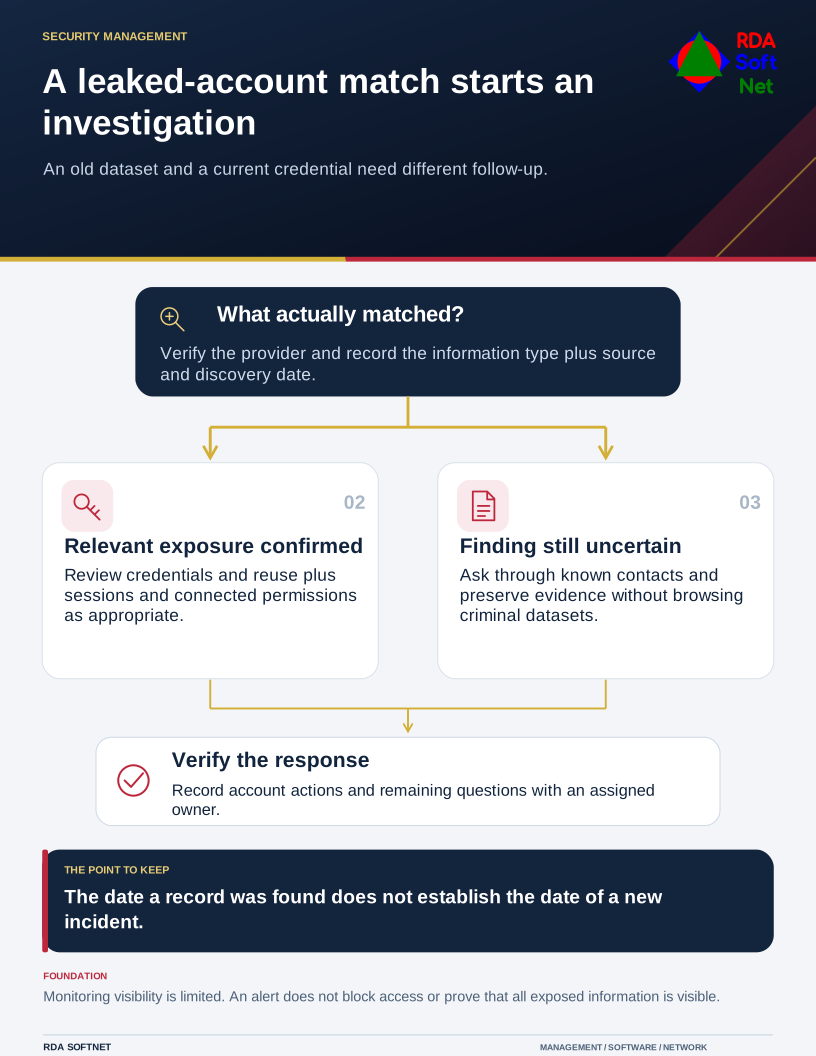
A leaked-account match starts an investigation
An old dataset and a current credential need different follow-up.
Services marketed as dark web monitoring vary in what they search, how they obtain findings, and how quickly they report them. No purchase should be treated as proof that every private marketplace or leaked record is visible to the provider.
Verify the alert through an established route
The FTC warns that messages about information on the dark web can themselves be phishing. Use a known provider address or contact method rather than the link or telephone number supplied in an unexpected alert.
For organizational accounts, send the finding to the responsible support or security team. Do not ask an employee to browse criminal sites or buy a leaked dataset. Avoid copying an exposed password into an ordinary ticket or email while trying to verify it.
Record the affected identity, alleged source, discovery date, and type of information, with appropriate protection. Distinguish the date a service found a record from the date an incident occurred. A rediscovered old dataset does not establish a new compromise of the current environment.
Choose the response from the evidence
If a relevant credential may be exposed, review the account through the credential management process. Actions can include replacing the password, addressing reuse, examining recovery methods, and checking active access and application permissions. The scope depends on what was exposed and what activity is found.
Protect important accounts with suitable authentication and recovery. An alerting service does not block a sign-in merely because it reported a password. Nor does a password change necessarily end every session or remove an unauthorized application grant.
If personal identity information is involved, use the breach notice guidance to consider appropriate monitoring, institution contacts, and official recovery resources. An identity record appearing in a dataset does not automatically mean a bank account was accessed, but unfamiliar activity warrants prompt attention.
Escalate suspected organizational compromise through incident response. Preserve relevant evidence and identify what remains unknown instead of declaring the environment safe because a lookup returned no additional findings.
Decide what the service adds
Before buying or renewing monitoring, ask what identities and data types it covers, which sources are represented, what the report contains, and who must act. Check how the provider protects the information supplied to it and what happens when staff leave.
Compare that arrangement with existing identity alerts and security operations. Useful monitoring produces actionable findings with an owner; duplicate alerts without a response plan can add noise.
RDA can help interpret a finding and coordinate account or incident work with the organization. Retain the decision and follow-up in the service record. The value lies in reducing a confirmed exposure or investigating a credible concern, not in promising that unseen information has been removed from every place it may exist.